A machine learning beginner's desperate attempt to document what I'm learning.
When reading scikit-learn sample code, I noticed that the same fit() method appears across many different models. Logistic regression and data standardization must be doing different things, so why do they use the same method?
After looking into it, I discovered that the reason lies in a shared design built around something called an estimator. In this post, I will focus on fit(), predict(), and transform() and organize what I have learned in my own words.
What You Can Do with scikit-learn
scikit-learn is a Python library for machine learning. In addition to classification, regression, clustering, and dimensionality reduction, it provides tools for preprocessing data and evaluating models.
At first, the number of available features felt overwhelming. However, the basic way they are used is remarkably consistent. Even when the model changes, the overall process remains largely the same: provide data, learn from it, and then make a prediction or transformation.
Estimators as a Common Starting Point
In scikit-learn, an object that learns something from data is called an estimator. Estimators generally provide a fit() method and implement additional methods depending on their role.
Role
Main Method
Examples
Estimator
fit()
LogisticRegression, StandardScaler
Predictor
predict()
Classifiers and regressors
Transformer
transform()
StandardScaler, PCA
A single class can have more than one role. LogisticRegression learns from data and makes predictions, while StandardScaler learns the mean and standard deviation of the data before transforming its values.
This design, in which different tools can be used in a consistent way, is one of the reasons scikit-learn is so approachable.
Learning from Data with fit()
fit() is the method that learns the necessary values from the data it receives.
In logistic regression, it learns the coefficients used for classification from the features and their correct labels.
from sklearn.linear_model import LogisticRegressionmodel = LogisticRegression()model.fit(X_train, y_train)
With StandardScaler, it stores the mean and standard deviation of the training data.
from sklearn.preprocessing import StandardScalerscaler = StandardScaler()scaler.fit(X_train)
Although both use the same fit() method, what they learn depends on the estimator.
Do not pass test data to fit()
If the test data is used to learn values such as means or coefficients, information that should remain unknown leaks into the model. This is called data leakage. Use fit() only with the training data.
Predicting Unseen Data with predict()
predict() passes new data to a trained model and returns a predicted class or numerical value.
y_pred = model.predict(X_test)print(y_pred)
A classifier returns class labels, while a regressor returns continuous numerical values. Classifiers that support probability estimates can also use predict_proba() to return the probability that each sample belongs to each class.
proba = model.predict_proba(X_test)print(proba)
It is important to remember that not every classifier provides predict_proba().
Transforming Data with transform()
transform() uses a fitted transformer to convert data into a different representation.
When standardizing data, the mean and standard deviation learned from the training data are used to transform both the training and test data according to the same 기준.
With StandardScaler, fit_transform(X_train) produces the same result as calling fit(X_train) followed by transform(X_train). However, this is not guaranteed for every transformer. Check the documentation for the class you are using.
Trying the Full Process with the Iris Dataset
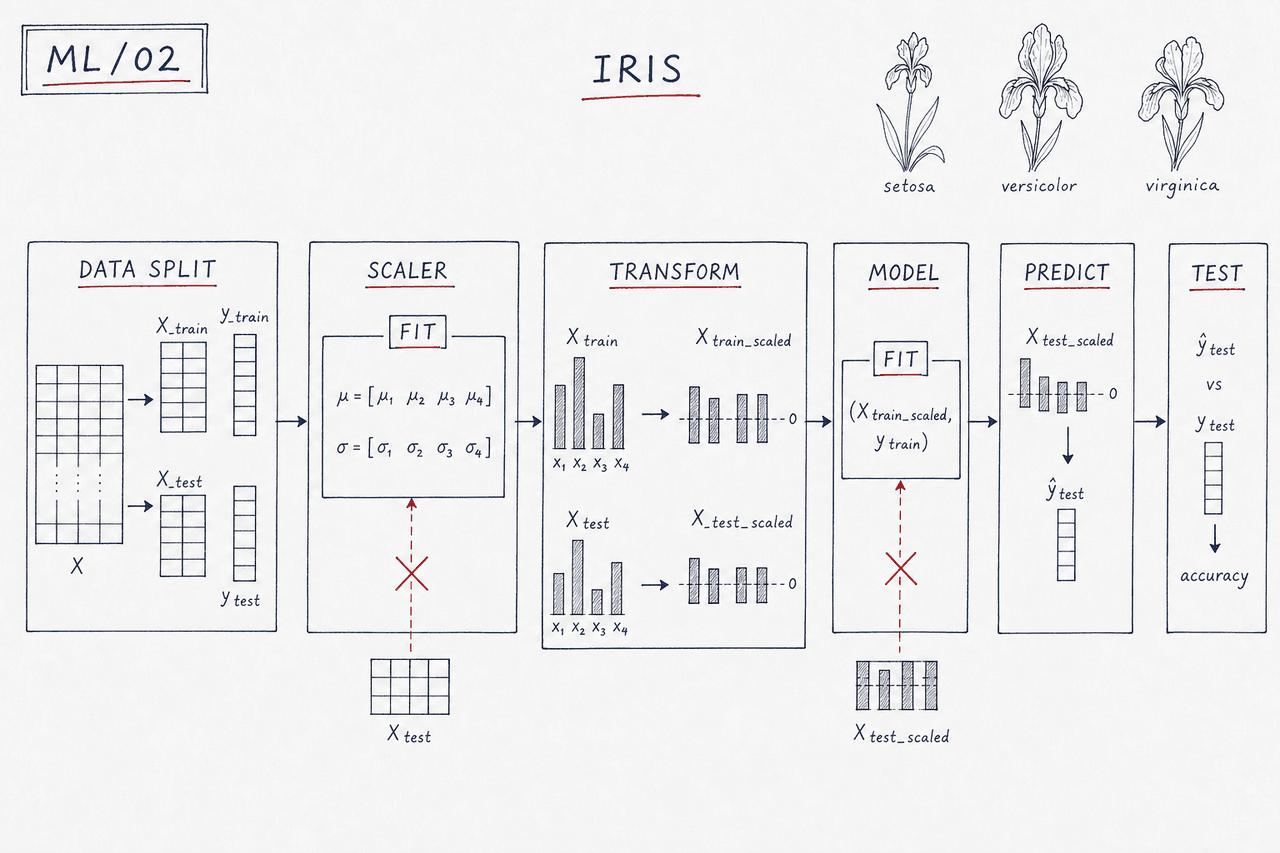
Using the Iris flower dataset, I will standardize the features and then classify the samples with logistic regression.
from sklearn.datasets import load_irisfrom sklearn.metrics import accuracy_scorefrom sklearn.model_selection import train_test_splitfrom sklearn.preprocessing import StandardScalerfrom sklearn.linear_model import LogisticRegression# Load the datairis = load_iris()X, y = iris.data, iris.target# Split the data into training and test setsX_train, X_test, y_train, y_test = train_test_split( X, y, test_size=0.2, random_state=42, stratify=y,)# Learn the scaling parameters from the training data# and transform both datasets using the same parametersscaler = StandardScaler()X_train_scaled = scaler.fit_transform(X_train)X_test_scaled = scaler.transform(X_test)# Train the modelmodel = LogisticRegression()model.fit(X_train_scaled, y_train)# Predict unseen data and evaluate the resulty_pred = model.predict(X_test_scaled)print(f"Accuracy: {accuracy_score(y_test, y_pred):.3f}")
Following the code makes the role of each step much clearer.
scaler.fit_transform() learns the scaling parameters from the training data while transforming it.
scaler.transform() applies the same scaling parameters to the test data.
model.fit() trains the classification model.
model.predict() predicts the labels of unseen data.
At first, fit(), predict(), and transform() looked like three unrelated spells. In reality, they form a shared interface built around three clear roles: learning, predicting, and transforming.
Even if the model is replaced with a different algorithm, the basic process remains almost unchanged. Next, I want to try combining the preprocessing steps and the model into a Pipeline.
 Yuto NagataStudent developer from Nagano writing about web development, Unity, and travel.